
Building Strong Financial Foundations for SME Growth
Introduction
Many SME owners share the same ambition: to grow their business, expand their reach, and create lasting impact in the local community. Yet too often, growth stalls not because of a lack of vision or hard work, but because the financial foundations aren’t strong enough to support it. Without clear systems, reliable cash flow, and a strategy that looks beyond the next quarter, even the most promising businesses can find themselves stuck.
Finance strategy isn’t just about numbers on a spreadsheet. It’s about creating confidence, resilience, and scalability. For SMEs, especially those navigating the local competitive landscape, a well-structured finance strategy is the difference between chasing growth and achieving it sustainably.
This article explores five essential pillars of finance strategy that every SME owner should consider. By strengthening these foundations, you’ll not only unlock growth opportunities but also build a business that can weather challenges and thrive in the long term.
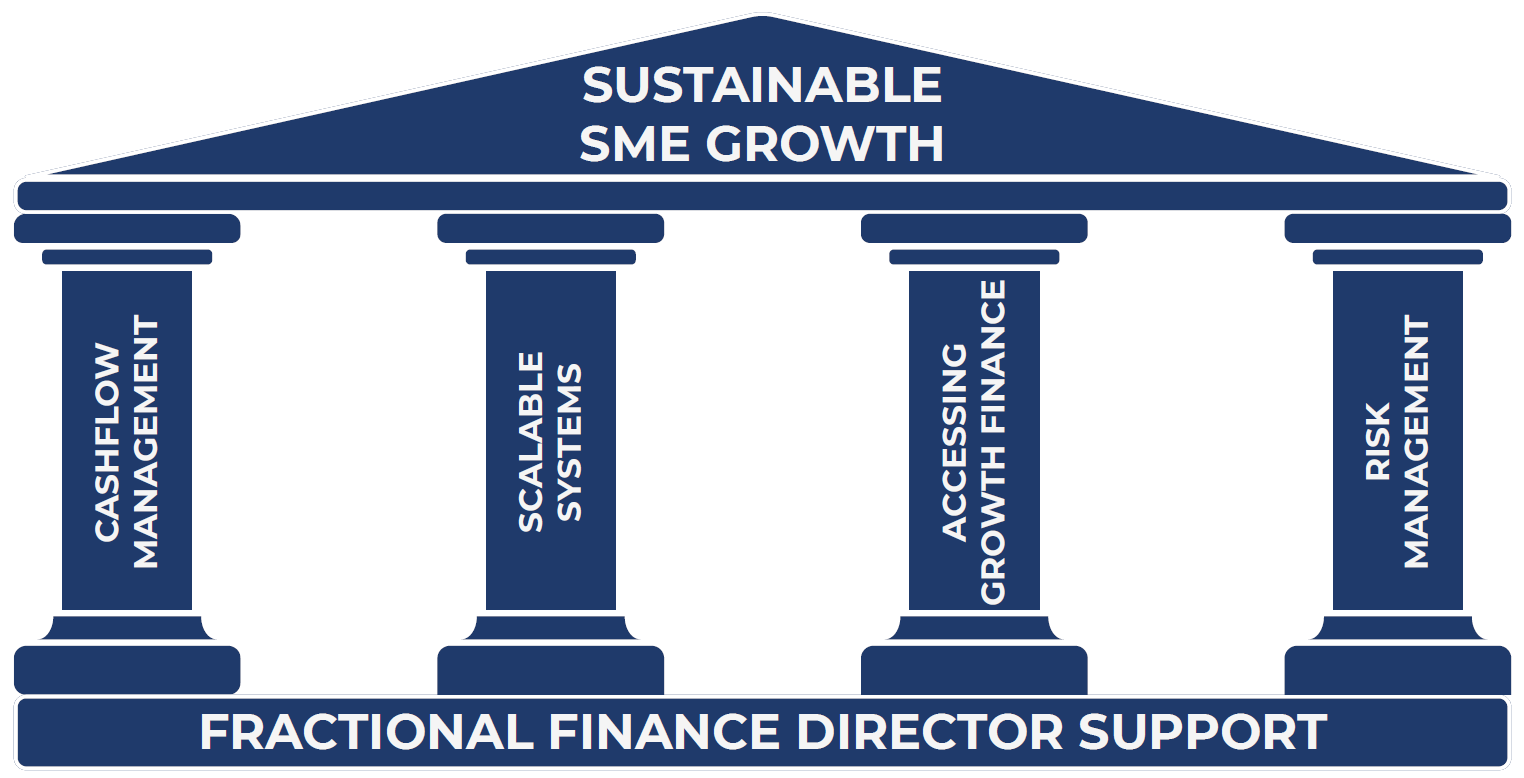
Pillar 1: Cash Flow Management and Forecasting
For many SMEs, cash flow is the silent killer of growth. It’s not the lack of profit that brings businesses down, but the inability to manage the timing of money coming in versus money going out. A strong finance strategy starts here: understanding, predicting, and controlling cash flow.
Why it matters:
- Growth requires investment. In people, systems, and marketing. But without visibility of cash flow, those investments can quickly become liabilities.
- Late payments from customers or unexpected expenses can derail even the most promising plans.
- Banks and investors look first at cash flow when assessing whether your business is stable enough to support growth.
Practical steps for SMEs:
- Build a rolling forecast to anticipate peaks and troughs.
- Segment inflows and outflows to identify pressure points.
- Automate invoice reminders and negotiate supplier terms.
- Use scenario planning to prepare for “what if” situations.
Local Context:
SMEs often operate in fast-moving sectors like logistics, retail, and professional services, cash flow volatility is common. A clear forecasting model not only helps you survive but positions you to seize opportunities. Whether that’s hiring talent, bidding for larger contracts, or expanding into new markets.
Pillar 2: Building Scalable Systems for Payroll, Compliance, Reporting and Supplier Invoicing and Payments
Growth isn’t just about winning new customers. It’s about ensuring your internal systems can keep pace. Many SMEs hit a ceiling because their payroll, compliance, reporting, and supplier invoicing/payment processes are manual, inconsistent, or overly dependent on one person. When these systems break down, trust erodes, compliance related risks increase and opportunities slip away.
Why it matters:
- Payroll errors damage employee morale and can lead to costly disputes.
- Compliance failures risk fines, reputational damage, and distraction from growth.
- Without reliable reporting, owners make decisions in the dark, missing chances to invest or pivot.
- Supplier invoicing and payments directly affect relationships with vendors. Late or inconsistent payments can strain partnerships and reduce negotiating power.
Practical steps for SMEs:
- Automate payroll and HR processes with cloud-based systems.
- Standardize compliance checks through SOPs for VAT, pensions, and HMRC filings.
- Design scalable reporting dashboards for real-time insights.
- Streamline supplier invoicing with purchase order matching and discrepancy checks.
- Simplify supplier payments with clear approval workflows and scheduled runs.
- Maintain audit-ready records to build investor and regulator confidence.
Local Context:
SMEs rely on strong supplier networks to deliver services and products quickly, efficient invoicing and payment systems are a competitive advantage. A business that can demonstrate clean payroll, compliant processes, transparent reporting, and reliable supplier payments will stand out in networks, attract talent, and win larger contracts.
Pillar 3: Accessing Growth Finance with Confidence
For many SMEs, the desire to grow is clear, but the path to funding that growth often feels uncertain. Owners may hesitate to approach banks, investors, or grant providers because they fear rejection or don’t know how to present their business case. A finance strategy removes that uncertainty by preparing you to access growth finance with confidence.
Why it matters:
- Growth requires capital: whether it’s hiring staff, investing in technology, or expanding into new markets.
- Without a clear plan, SMEs risk taking on unsuitable debt or missing out on funding opportunities.
- Investors and lenders look for businesses with strong foundations, reliable cash flow, clean reporting and a clear growth story.
Practical steps for SMEs:
- Explore diverse funding sources: loans, grants, angel investors or crowdfunding.
- Strengthen your pitch with growth plans backed by forecasts and KPIs.
- Leverage networks for introductions and workshops.
- Build credibility through compliance, reporting and supplier trust.
- Diversify funding sources to avoid over-reliance on one lender.
Local Context:
SMEs benefit from a thriving business ecosystem with access to regional growth hubs and government-backed schemes. By approaching finance strategically, owners can move from uncertainty to confidence. Securing the capital they need to scale sustainably.
Pillar 4: Risk Management and Resilience Planning
Every business faces risks. From economic downturns and supply chain disruptions to regulatory changes and unexpected crises. For SMEs, these risks can feel overwhelming, especially when resources are limited. A strong finance strategy doesn’t eliminate risk, but it equips you to anticipate, prepare, and respond with resilience.
Why it matters:
- Unmanaged risks can wipe out profits and stall growth.
- Resilience planning ensures your business can adapt quickly, protecting jobs and customer relationships.
- Lenders and investors are more confident in businesses that demonstrate proactive risk management.
Practical steps for SMEs:
- Map out financial, operational, and external risks.
- Create contingency reserves covering at least three months of costs.
- Diversify suppliers and customers to reduce dependency.
- Document workflows and train staff for crisis response.
- Use scenario planning to model different outcomes.
Local Context:
SMEs benefit from a dynamic business environment but also face risks tied to rapid growth and competitive markets. By embedding resilience into your finance strategy, you not only protect your business but also position it as a reliable partner within your network.
A reputation that attracts customers, suppliers, and investors alike.
Foundation: Embedding Financial Literacy Across the Business
A finance strategy isn’t just the responsibility of the owner or the accountant. It’s a mindset that should run through the entire business. When employees understand the basics of finance, they make smarter decisions, spot risks earlier and contribute to growth more effectively.
Embedding financial literacy is about creating a culture where everyone feels confident engaging with numbers.
Why it matters:
- Decisions made at every level, from ordering supplies to negotiating contracts have financial implications.
- A financially aware team reduces errors, improves efficiency, and strengthens accountability.
- Investors and lenders value businesses where financial discipline is embedded across the organisation.
Practical steps for SMEs:
- Offer workshops or lunch-and-learn sessions on cash flow, invoicing, and expense management.
- Share clear, visual dashboards highlighting key metrics.
- Empower managers with access to relevant financial data.
- Celebrate financial wins to reinforce positive behaviours.
- Encourage open conversations about financial challenges and opportunities.
Local Context:
SMEs thrive on collaboration and community. By embedding financial literacy, you not only strengthen your internal culture but also position your business as a trusted, resilient partner within your network. A financially confident team is better equipped to seize opportunities, adapt to challenges, and drive sustainable growth.
Conclusion
Turning Foundations into Sustainable Growth
For SME owners, growth isn’t just about ambition. It’s about building the right foundations to make that ambition achievable. By mastering cash flow, creating scalable systems for payroll, compliance, and supplier payments, accessing growth finance with confidence, embedding resilience into your planning and fostering financial literacy across your team, you transform finance from a barrier into a catalyst.
The journey to sustainable growth begins with intentionality. Each pillar strengthens the others: cash flow supports investment, systems build trust, finance fuels expansion, resilience protects against shocks and literacy empowers your people. Together, they create a strategy that doesn’t just chase growth but sustains it.
This is where a fractional Finance Director can make a decisive difference. Unlike a full-time FD, a fractional FD provides strategic expertise on a flexible, affordable basis. Ideal for SMEs that need high-level guidance without the overhead. They can:
- Translate complex financial data into clear, actionable insights for non-finance owners.
- Design scalable systems and controls that grow with the business.
- Guide funding applications and investor pitches with credibility.
- Build resilience frameworks and ensure compliance without slowing down operations.
- Coach teams to improve financial literacy and embed accountability across the business.
With the right financial strategy and the guidance of a fractional Finance Director your business can move beyond uncertainty, seize opportunities and leave a lasting legacy of resilience and success.